
Sleep feels impossible when you have PTSD. You lie down exhausted, but your brain stays on high alert. Your body is ready to fight or flee. The quiet of the night becomes a stage for intrusive thoughts, hypervigilance, and nightmares. If this sounds familiar, you are not broken. There is a deep biological reason why PTSD and sleep are so tangled. And the good news is that you can untangle them.
PTSD keeps your nervous system stuck in survival mode, which directly blocks deep sleep. Poor sleep then makes PTSD symptoms worse, creating a cycle. But you can break that cycle. By understanding how trauma changes your sleep architecture, you can use targeted strategies like grounding before bed, CBT-I techniques, and nightmare reprocessing to reclaim rest. Recovery starts with one good night.
Why Your Brain Refuses to Sleep After Trauma
Your brain has a smoke detector called the amygdala. After trauma, that detector gets hypersensitive. It scans for danger even when you are safe in bed. Meanwhile, the prefrontal cortex, the part that says “you are fine, go to sleep,” gets quieter. This imbalance is the core of the PTSD and sleep struggle.
Your sleep cycles change too. You spend less time in restorative deep sleep and more time in light, easily disturbed sleep. Your body stays flooded with cortisol and adrenaline. That makes falling asleep hard and staying asleep even harder.
The Two-Way Street Between PTSD and Sleep
Many people think sleep problems are just a symptom of PTSD. But research shows the relationship goes both ways. Poor sleep can make your brain less able to process traumatic memories. When you are sleep deprived, your amygdala becomes even more reactive. Your emotional brakes stop working.
This means that fixing your sleep is not just about feeling rested. It is a direct part of your trauma recovery. When you improve sleep, you give your brain the chance to process what happened. You strengthen the neural pathways that help you feel safe.
What Happens When You Do Not Get REM Sleep
Rapid eye movement (REM) sleep is the stage where your brain processes emotions and memories. It is like your brain’s nightly therapy session. With PTSD, your REM sleep gets fragmented. You might enter REM too early or get stuck in it, which is when nightmares happen.
When you miss out on quality REM sleep, traumatic memories stay unprocessed. They remain raw and intrusive. That is why you might wake up feeling like you barely slept even if you were in bed for eight hours. Your brain did not get the repair time it needed.
5 Common Sleep Disruptions in PTSD Recovery
Not all sleep problems look the same. Here are the most common patterns people experience:
- Sleep onset insomnia: You feel wired when you hit the pillow. Your mind races with “what if” scenarios.
- Nightmares and night terrors: Your brain replays the trauma or creates new frightening scenarios.
- Fragmented sleep: You wake up multiple times during the night, often without realizing it.
- Sleep avoidance: You stay up late because you dread the nightmares or the vulnerability of sleep.
- Delayed sleep phase: Your natural body clock shifts so you fall asleep very late and struggle to wake up.
Each of these patterns needs a slightly different approach. The table below breaks down what to try for each one.
A Simple Table to Match Your Problem with a Solution
| If you struggle with… | Try this approach |
|---|---|
| Racing thoughts at bedtime | A 10 minute grounding routine using sensory focus (what you can see, hear, feel) |
| Nightmares | Imagery Rehearsal Therapy (IRT) to rescript the dream during the day |
| Waking up multiple times | Check for sleep apnea or hyperarousal triggers like caffeine after 2 p.m. |
| Avoiding sleep entirely | Create a wind down ritual that starts 90 minutes before bed |
| Delayed sleep phase | Morning sunlight exposure within 30 minutes of waking to reset your clock |
How to Build a Bedtime Routine That Works for Trauma Survivors
A standard sleep hygiene list might tell you to “relax before bed.” That advice is useless when your nervous system is screaming. You need a routine that actively calms your survival brain.
Step 1: Signal safety to your body.
Use heavy blankets or weighted blankets. Deep pressure touch lowers cortisol. You can also try slow, exhale focused breathing. Breathe in for four counts, out for six. This activates your vagus nerve and tells your body it is safe.
Step 2: Create a physical boundary.
Change into sleep clothes that feel comfortable, not restrictive. Make your room as dark as possible. Blackout curtains help. If you need a nightlight, use a dim red light. Blue light suppresses melatonin.
Step 3: Use a transition activity.
Do not go straight from a stressful task to bed. Spend 15 minutes on something neutral and calming. Fold laundry. Pet your dog. Listen to the same song every night. This tells your brain “the day is over.”
Step 4: Write down what is stuck.
Keep a notebook by your bed. Write down any worries, intrusive thoughts, or memories that come up. Tell yourself you can deal with them tomorrow. This externalizes the thoughts so they stop looping in your head.
Step 5: Use a body scan.
Lie down and mentally scan from your toes to your head. Notice tension without trying to change it. Just noticing often helps the tension release on its own.
“The goal is not to force sleep. The goal is to create the conditions where sleep can happen naturally. When you have PTSD, your nervous system needs extra help feeling safe enough to let go.” Dr. Arielle Schwartz, clinical psychologist and trauma specialist.
Why Therapy for Sleep Works When Willpower Does Not
You cannot outsmart a dysregulated nervous system with sheer will. That is why structured treatments work better than trying harder. Cognitive Behavioral Therapy for Insomnia (CBT-I) is one of the most effective approaches. It addresses the thoughts and behaviors that keep you awake.
CBT-I includes:
– Sleep restriction to rebuild sleep drive.
– Stimulus control (only using your bed for sleep).
– Cognitive restructuring to challenge beliefs like “I will never sleep well again.”
For nightmares, Imagery Rehearsal Therapy (IRT) is a powerful tool. You recall the nightmare during the day and rewrite the ending. You practice the new version until your brain starts using it. This does not erase the memory, but it reduces its emotional charge.
If you are interested in broader treatment options, you can read more about top evidence-based approaches to healing from trauma and PTSD.
What to Do When You Wake Up from a Nightmare
Waking up from a nightmare feels like the trauma is happening all over again. Your heart pounds. You feel disoriented. In that moment, your brain does not know it is the past.
Here is a numbered process to follow:
- Stay in bed if you can. Getting up too fast can reinforce the fear. Take three slow breaths first.
- Name the present. Say out loud or in your head: “I am in 2026. I am in my bedroom. The event is over. I am safe now.”
- Use a physical anchor. Press your feet into the mattress. Squeeze your pillow. Feel the texture of your sheets.
- Turn on a dim light. A soft lamp or salt lamp works. Bright light can feel jarring.
- Do not replay the nightmare. Instead, redirect your mind to a neutral memory. What did you have for dinner? What is your favorite song?
- Get a drink of water. Hydration helps ground you in your body.
- If you cannot fall back asleep within 20 minutes, get up. Sit in a chair and read a calm book until you feel drowsy again.
Medications That Can Help or Hurt
Some medications for PTSD can disrupt sleep. Prazosin is one of the few medications specifically shown to reduce nightmares. It works by blocking the effects of norepinephrine, the chemical that keeps you on alert.
SSRIs like sertraline (Zoloft) can help overall PTSD symptoms, but they may cause insomnia or vivid dreams in some people. Always talk to your doctor about timing. Taking medication in the morning instead of at night can reduce sleep disruption.
Avoid using alcohol or cannabis to sleep. They may help you fall asleep faster, but they suppress REM sleep and make nightmares more likely later in the night.
How to Know If You Need a Sleep Study
If you have tried basic changes and still wake up exhausted, you might have an underlying sleep disorder. Sleep apnea is common in people with PTSD. The constant waking at night can mimic insomnia but is actually a breathing problem.
Signs you might need a sleep study:
– You snore loudly.
– You wake up with a dry mouth or headache.
– You feel tired even after 8 hours in bed.
– You wake up gasping for air.
A sleep study can tell you if your brain is waking up due to breathing pauses. Treating sleep apnea can dramatically improve your PTSD symptoms.
Building Resilience Through Rest
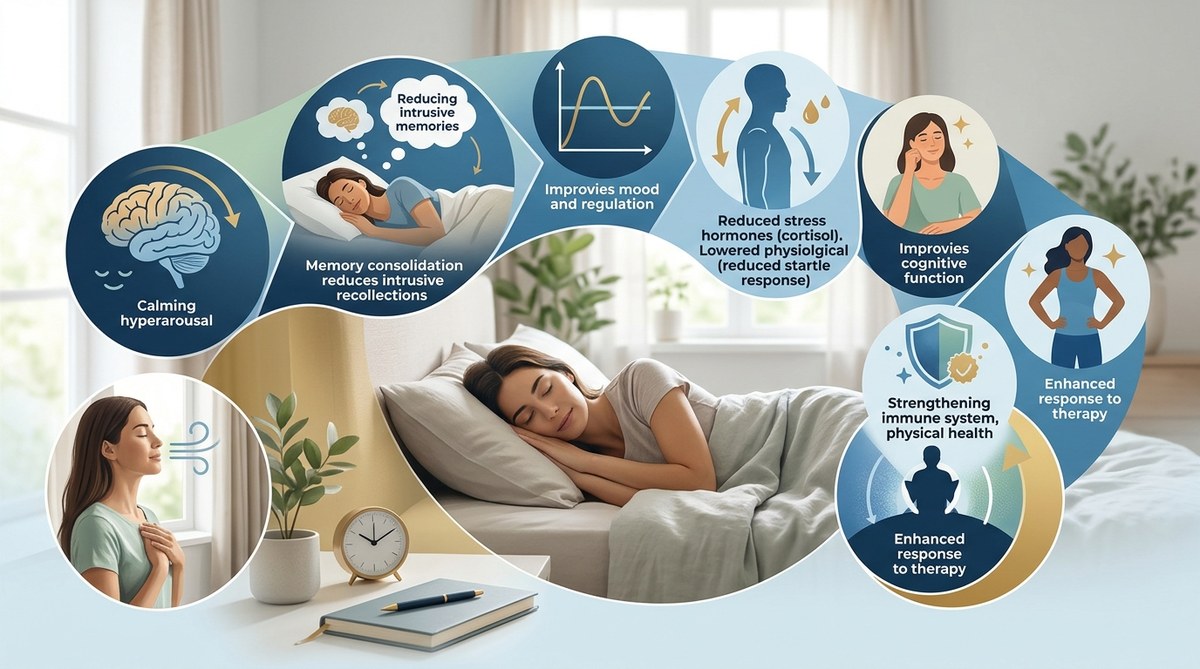
Improving sleep is not a luxury. It is a foundation of recovery. When you sleep well, your immune system works better. Your emotional regulation improves. You have more patience for therapy and daily life.
If you are looking for more ways to support your nervous system during the day, check out these 7 daily habits to regulate your nervous system after trauma. Small daytime practices make nighttime rest easier.
What Recovery Looks Like When Sleep Gets Better
People often describe it as a fog lifting. You start to trust your body again. You realize that rest is possible. Nightmares become less frequent. You wake up and remember you are in the present, not the past.
Recovery is not linear. You will have bad nights. But when you understand the connection between PTSD and sleep, you stop blaming yourself. You start treating your sleep problems as a biological response, not a personal failure.
Your First Step Toward Better Rest Tonight
You do not need to fix everything at once. Pick one small change from this article. Maybe it is the breathing exercise. Maybe it is writing down your worries. Maybe it is talking to your doctor about prazosin.
Start there. Be consistent. Give it a week. Your brain is capable of healing, and sleep is one of the most powerful tools you have.
If you want a deeper understanding of how trauma changes your brain, read about what happens in your brain during trauma. Knowledge is a form of power when you are healing.