
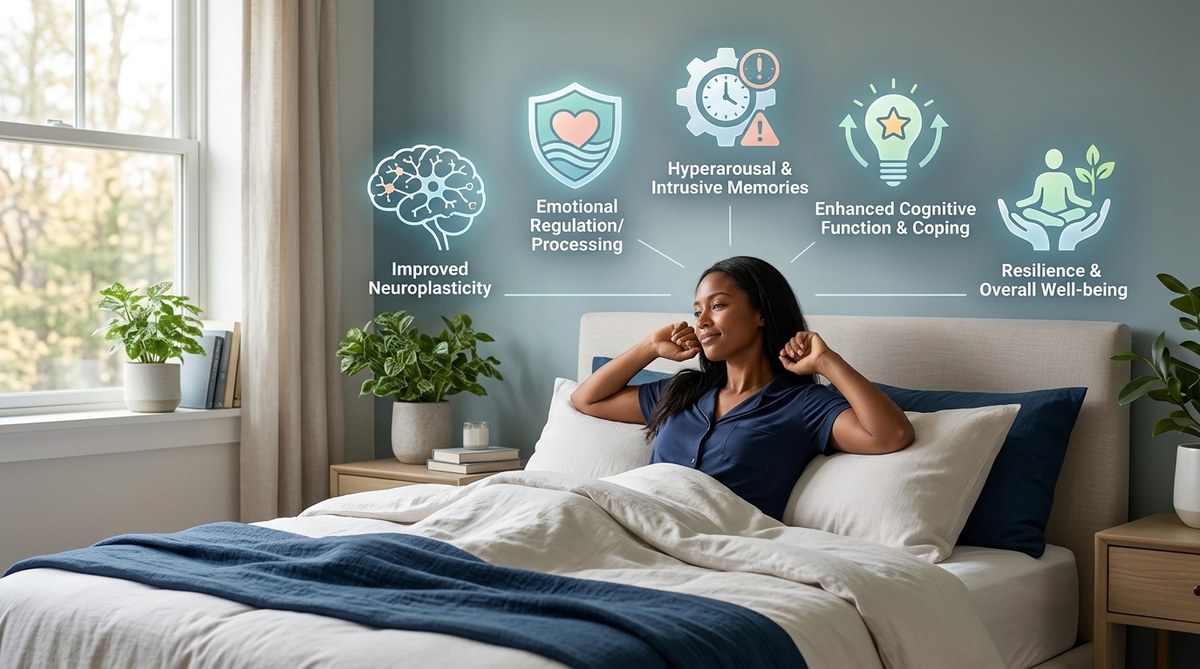
Sleep can feel impossible when you live with PTSD. You lie down exhausted, but your brain stays on high alert. Your heart races at every sound. Nightmares pull you back into the trauma. Then morning comes, and you feel worse than when you went to bed. This is not a failure on your part. It is a biological cycle that many trauma survivors face.
Sleep and PTSD share a two-way street. Poor sleep makes trauma symptoms worse, and PTSD actively disrupts the sleep your brain needs to heal. The good news is that improving your sleep can reduce nightmare frequency, lower daytime anxiety, and help therapy work better. Small changes to your bedtime routine and environment can break the cycle.
The Hidden Link Between PTSD and Sleep
Most people think of PTSD as a daytime problem. You deal with triggers, flashbacks, and hypervigilance while you are awake. But your nervous system does not clock out when you go to bed. In fact, your brain does some of its most important trauma processing while you sleep.
Research shows that about 70 percent of people with PTSD report sleep disturbances. That number is not a coincidence. Your brain needs deep sleep and REM sleep to file away emotional memories. When you have PTSD, your brain stays stuck in survival mode. It struggles to enter the deep, restorative stages of sleep. Instead, you spend more time in light sleep, which leaves you feeling restless and on edge.
This creates a loop. Poor sleep makes your amygdala more reactive, so you feel more afraid during the day. That fear makes it harder to fall asleep at night. Understanding this cycle is the first step to breaking it.
How Nightmares Affect Your Recovery
Nightmares are one of the most distressing symptoms of PTSD. They are not just bad dreams. They are often direct replays of the traumatic event, and your body reacts as if the trauma is happening right now. Your heart rate spikes. Stress hormones flood your system. You wake up in fight or flight mode.
The real problem is what happens after you wake up. Your sleep is fragmented, so your brain never gets the uninterrupted REM cycles it needs to process the memory. This keeps the trauma fresh and unprocessed. Over time, you may start to fear going to sleep at all. That avoidance makes the whole cycle worse.
If you experience nightmares regularly, you are not alone. Many trauma survivors find that their sleep quality directly predicts how they feel the next day. A bad night of sleep often leads to more intrusive thoughts, higher irritability, and lower patience.
Three Practical Ways to Improve Sleep with PTSD
You do not need to fix your sleep all at once. Small, consistent steps can shift your nervous system toward rest. Try these three strategies this week.
-
Create a buffer zone before bed. Stop looking at screens at least 60 minutes before you plan to sleep. The blue light from phones and laptops tricks your brain into thinking it is daytime. Instead, do something calming. Read a physical book. Take a warm shower. Listen to music without lyrics. This signals to your body that it is safe to power down.
-
Use a grounding ritual if you wake up scared. When a nightmare wakes you, do not try to force yourself back to sleep immediately. Sit up. Turn on a soft lamp. Name five things you can see in the room. This helps your brain remember that you are in the present, not in the trauma. After you feel grounded, try a few slow breaths before lying back down.
-
Keep your bedroom for sleep only. Your brain learns associations. If you spend hours lying awake worrying in bed, your brain starts to see the bed as a place of stress. If you cannot fall asleep after 20 minutes, get up and go to another room. Do something relaxing until you feel drowsy. Then return to bed.
What Helps and What Hurts: A Simple Guide
Not all sleep advice works for people with PTSD. Some standard tips can actually backfire. Here is a breakdown of what tends to help and what might make things worse.
| Helpful Approach | Why It Works | Common Mistake | Why It Backfires |
|---|---|---|---|
| Consistent wake time | Regulates your body’s internal clock | Forcing sleep at a set time | Increases pressure and anxiety |
| Weighted blanket | Provides calming deep pressure | Using heavy blankets in hot weather | Can cause overheating and restlessness |
| White noise machine | Masks startling sounds | Using nature sounds with sudden bird calls | Unexpected noises can trigger hypervigilance |
| Writing before bed | Offloads racing thoughts | Writing in detail about the trauma | Can increase arousal before sleep |
| Gentle movement in the evening | Releases tension | High intensity exercise late at night | Raises heart rate and cortisol |
The key is to pay attention to how each strategy makes you feel. If something increases your anxiety, stop using it. Your goal is to calm your nervous system, not to follow a rigid set of rules.
Why Sleep Helps Therapy Work Better
If you are in therapy for PTSD, sleep quality matters more than you might think. Therapy, especially trauma focused approaches like EMDR or cognitive processing therapy, relies on your brain’s ability to form new connections. Sleep is when those connections get strengthened.
When you are sleep deprived, your prefrontal cortex, the part of your brain that helps you think logically and regulate emotions, does not function as well. This makes it harder to challenge irrational fears or practice new coping skills. On the other hand, when you are well rested, you are more able to engage with therapy and apply what you learn.
“Sleep is not a luxury during trauma recovery. It is a biological necessity. Your brain uses sleep to sort through the day’s experiences and file them away. Without enough quality sleep, traumatic memories stay stuck in a raw, unprocessed state.” (Dr. Rachel Holloway, trauma sleep specialist)
If you have a therapy session coming up, prioritize your sleep the night before and the night after. That is when your brain is most receptive to change.
A Simple Evening Routine to Try Tonight
You do not need a complicated plan. Here is a routine that takes about 30 minutes and can be adjusted to fit your life.
- Step one: At the same time each evening, dim the lights in your home. This tells your brain that the day is ending.
- Step two: Do one gentle activity. This could be stretching, slow breathing, or petting an animal. The activity does not matter as much as the calm feeling it creates.
- Step three: Write down anything on your mind. It can be a worry, a memory, or just a list of things you need to do tomorrow. Getting it on paper gets it out of your head.
- Step four: Get into bed and use a grounding technique if you feel anxious. Place your hand on your chest and feel your breath move. Remind yourself that you are safe in this moment.
Repeat this routine for at least one week before judging the results. Your nervous system needs time to learn new patterns.
When to Seek Professional Help
Sometimes sleep problems are too severe to manage on your own. If you have tried consistent routines and still feel exhausted, or if nightmares happen multiple times a week, it may be time to talk to a professional. Therapies like imagery rehearsal therapy are specifically designed to reduce PTSD related nightmares. A trauma informed therapist can also help you address the underlying sleep avoidance that often develops after trauma.
You can learn more about how therapy fits into the bigger picture by reading about understanding the role of therapy in healing from PTSD. If you are looking for ways to manage symptoms during the day, check out these effective strategies for managing PTSD symptoms daily.
Small Steps Lead to Better Rest
You do not have to master sleep overnight. Healing from trauma is not linear, and neither is improving your sleep. Some nights will be harder than others. That is normal. What matters is that you keep showing up for yourself.
Start with one change. Maybe it is turning off your phone an hour before bed. Maybe it is using a weighted blanket. Maybe it is simply allowing yourself to rest without guilt. Over time, those small choices add up. Your brain will begin to trust that nighttime can be safe. And as your sleep improves, your PTSD symptoms may start to feel more manageable too.
You deserve rest. You deserve to wake up feeling a little lighter. And with the right tools, you can get there.