
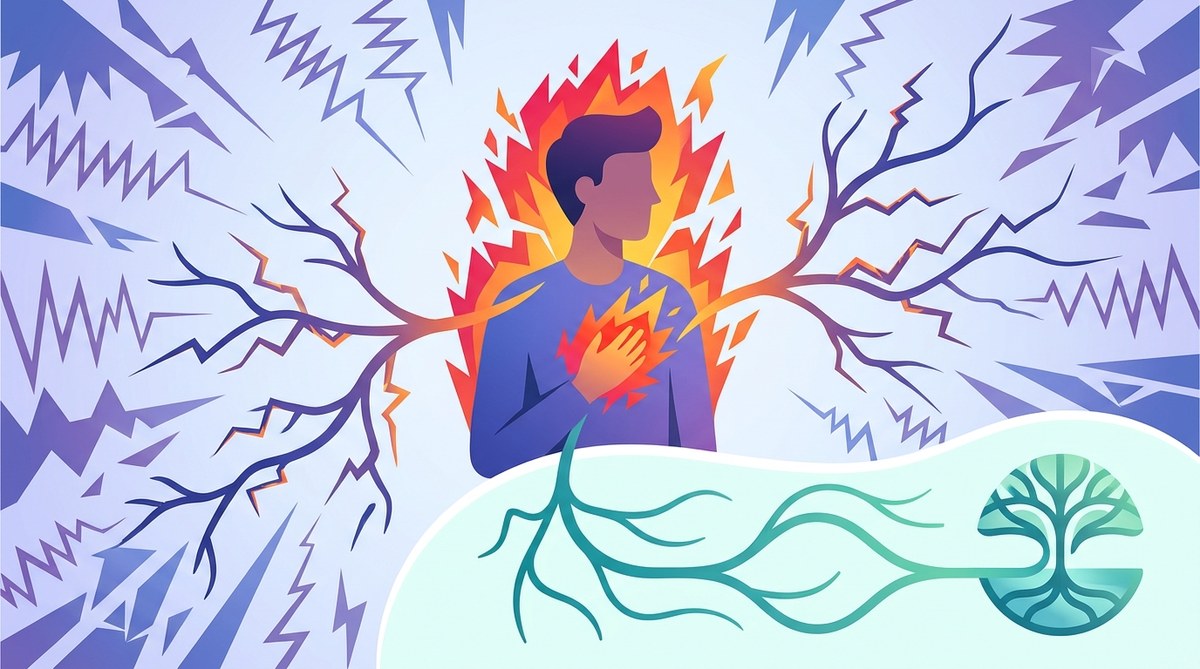
Your body feels like it is bracing for impact, even when you are sitting on your couch. The smallest noise makes you jump. Your jaw is clenched, your shoulders are tight, and your mind races through worst-case scenarios while you try to fall asleep. If this sounds familiar, you are not broken. You are not overreacting. You are likely experiencing a state called chronic hyperarousal, a common but often misunderstood sign that your nervous system is stuck in survival mode.
Chronic hyperarousal happens when your nervous system stays locked in fight or flight long after the danger has passed. The five most common signs are persistent anxiety, hypervigilance, physical tension, sleep disruption, and emotional reactivity. Recognizing these signs is the first step toward regulation. You can learn to calm your system with focused techniques, professional support, and daily practices that rebuild a sense of safety.
What Does It Mean to Be Stuck in Fight or Flight?
Your nervous system has a built-in alarm. When it senses a threat, it floods your body with stress hormones like cortisol and adrenaline. Your heart beats faster. Your muscles tense. Your focus narrows. This response saved your ancestors from predators, and it protects you in dangerous situations today.
The problem starts when the alarm never turns off.
For trauma survivors, the brain learns that the world is unsafe. It keeps the threat detection system on high alert, even in neutral or safe environments. This state is called chronic hyperarousal. It is not a choice or a character flaw. It is a biological adaptation that has outlived its usefulness.
The 5 Key Signs of Chronic Hyperarousal After Trauma
If you have been wondering whether your nervous system is stuck, look for these five signs. You do not need to have all of them to be struggling. Even one or two can significantly impact your quality of life.
1. Persistent Anxiety That Feels Out of Proportion
You feel anxious, but you cannot always point to a reason. Your worry is vague, constant, and exhausting. Small stressors trigger a full-body alarm. A text from your boss, a traffic jam, or an unexpected visitor can send your heart racing.
This is not regular nervousness. It is a nervous system that has lost its ability to distinguish between a real threat and a perceived one. The amygdala, the brain’s fear center, is working overtime. It is scanning for danger everywhere, even when you are safe.
2. Hypervigilance and an Inability to Relax
Hypervigilance is the feeling of being “on” all the time. You notice every sound, every movement, every change in someone’s facial expression. You sit with your back to the wall in restaurants. You scan parking lots for exits. You struggle to let your guard down, even with people you trust.
This state is exhausting. It takes a massive amount of energy to stay that alert. Many people with hypervigilance report feeling drained by midday, unable to rest even when they have time off. For a deeper understanding of what triggers this state, read our guide on understanding trauma triggers and how to overcome them.
3. Chronic Physical Tension and Pain
Your body holds the score. Chronic hyperarousal often shows up as tight shoulders, a clenched jaw, headaches, back pain, or digestive issues. You might notice that you grind your teeth at night or that your hands are always balled into fists.
This tension is your body preparing to fight or flee. Over time, it leads to inflammation and strain. If you are curious about the physical toll trauma takes, check out our article on 5 physical symptoms of trauma you shouldn’t ignore.
4. Disrupted Sleep and Restlessness
Falling asleep feels impossible. Your mind races. Your body feels wired. Even when you do sleep, you wake up frequently, often feeling unrefreshed. You might have vivid nightmares or wake up with a start in the middle of the night.
Sleep is the first thing to go when your nervous system is stuck on high alert. Your brain is too busy scanning for threats to allow for deep, restorative rest. This creates a cycle: poor sleep makes you more reactive during the day, and more reactivity makes it harder to sleep at night.
5. Emotional Reactivity and Mood Swings
Small frustrations turn into big reactions. You might snap at a loved one over a minor issue, cry during a commercial, or feel a surge of anger that feels disproportionate to the situation. Afterward, you feel ashamed or confused.
This is not a lack of control. It is a sign that your emotional regulation system is overwhelmed. Your threshold for tolerance is lower because your nervous system is already running hot. You have less capacity to handle additional stress.
What Makes Hyperarousal Different From Everyday Stress?
It is helpful to see the contrast between normal stress and chronic hyperarousal. The table below breaks down the key differences.
| Aspect | Normal Stress Response | Chronic Hyperarousal |
|---|---|---|
| Trigger | Specific, identifiable event | Persistent, often no clear trigger |
| Duration | Ends when the stressor ends | Continues for weeks, months, or years |
| Physical sensation | Temporary tension, then release | Constant muscle tightness and pain |
| Sleep impact | Occasional poor sleep | Chronic insomnia or restless sleep |
| Emotional state | Temporary irritability or worry | Baseline anxiety and reactivity |
| Recovery | Returns to baseline quickly | Struggles to find any baseline |
If you see yourself in the right column, know that your nervous system is not broken. It is doing exactly what it was trained to do. The good news is that you can retrain it.
A Simple Process to Start Calming Your Nervous System
Regulation is a skill. It takes practice, patience, and compassion. Here is a numbered process to begin shifting out of chronic hyperarousal.
-
Pause and notice without judgment. The first step is awareness. When you feel the signs of hyperarousal, pause. Notice your breath, your heart rate, and the tension in your body. Do not try to change anything. Just observe. This simple act of noticing activates the prefrontal cortex, which can help calm the amygdala.
-
Use a grounding technique. Grounding brings your attention back to the present moment. Try the 5-4-3-2-1 method. Name five things you can see, four things you can touch, three things you can hear, two things you can smell, and one thing you can taste. This shifts your brain out of threat mode.
-
Regulate your breath. Slow, deep breathing signals safety to your nervous system. Try box breathing. Inhale for four counts, hold for four counts, exhale for four counts, hold for four counts. Repeat for one to two minutes.
-
Move your body. Trauma gets trapped in the body. Gentle movement like walking, stretching, or shaking your hands and arms can help release stored tension. Even a few minutes of movement can shift your state.
-
Reach out for support. You do not have to do this alone. Talking to a trusted friend or a trauma-informed therapist can help you feel less isolated. If you are ready to explore professional options, learn more about understanding the role of therapy in healing from PTSD.
Common Mistakes People Make When Trying to Regulate
Many people try to force their nervous system to calm down. This usually backfires. Here are a few common mistakes to avoid.
- Ignoring the signals. Pushing through the tension and pretending everything is fine only reinforces the alarm state. Your body needs you to listen.
- Using substances to numb. Alcohol, caffeine, or recreational drugs can temporarily mask the symptoms, but they often worsen the underlying dysregulation.
- Comparing your recovery to others. Everyone’s nervous system is different. Your healing timeline is valid, even if it looks different from someone else’s.
- Skipping the basics. Sleep, hydration, and nutrition are foundational. If you are not taking care of these, regulation will be much harder.
“Healing does not mean the trauma never happened. It means the nervous system no longer lives in the past. It learns that the present is safe.” — Dr. Stephen Porges, Polyvagal Theory
When to Seek Professional Help
Self-regulation techniques are powerful, but they are not a substitute for professional care. If your symptoms feel unmanageable, or if you have been stuck in hyperarousal for months or years, consider reaching out to a trauma specialist.
Therapies like EMDR, Somatic Experiencing, and Trauma-Focused CBT are specifically designed to help the nervous system process and release trauma. You can read more about 7 evidence-based trauma treatments you should know about in 2026 to find an approach that fits your needs.
You might also benefit from learning about how to create a trauma-informed self-care routine that actually works. Small, consistent actions build the foundation for lasting change.
Your Nervous System Can Learn Safety Again
Living with chronic hyperarousal feels like being trapped in a body that will not listen. You want to relax, but you cannot. You want to feel safe, but you do not. This is not your fault. Your nervous system learned to protect you, and it is still trying to do its job.
The path forward is not about forcing yourself to calm down. It is about teaching your system, gently and repeatedly, that you are safe now. Each grounding breath, each moment of noticing without judgment, each conversation with a therapist is a small step toward regulation.
Start with one sign from this list. Pick one technique. Try it today. That is enough. You deserve to feel at home in your body again.