
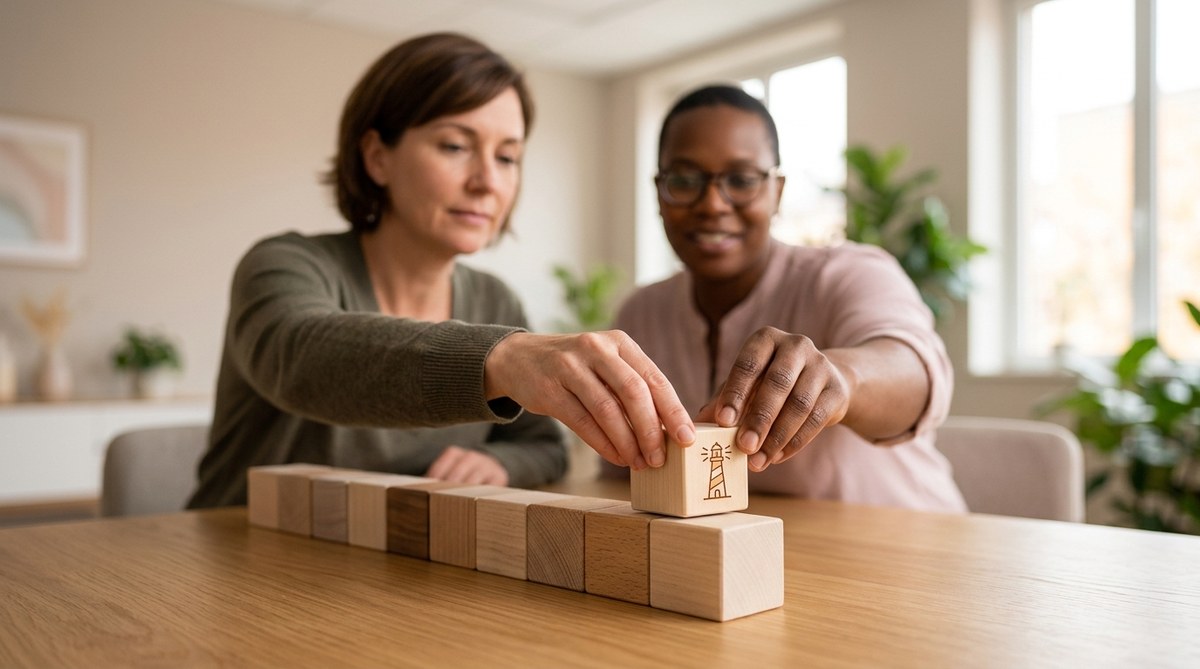
Trust is the invisible thread that connects us to ourselves and to other people. After a traumatic experience, that thread can feel broken, frayed, or completely gone. You might find yourself questioning everyone around you. You might even struggle to trust your own instincts, your own memory, or your own body. This is not a sign of weakness. It is a natural response to an overwhelming event. The good news is that trust can be rebuilt. It takes time, patience, and a clear process, but it is absolutely possible. This guide is designed to walk you through exactly how to do that, one step at a time.
Rebuilding trust after trauma is a gradual process that starts with self-compassion and small, safe actions. This guide provides a clear, structured approach to restore trust in yourself and in others. By learning to set healthy boundaries, communicate needs clearly, and take small risks in safe relationships, you can rebuild the foundation of trust that trauma damaged.
Why Trauma Makes Trust Feel Impossible
Trauma changes how your brain processes safety. Your nervous system gets stuck in a heightened state of alert. It is constantly scanning for threats, even when you are in a safe environment. This is your brain trying to protect you. The problem is that this protective mechanism also makes it very hard to trust.
When you have been hurt, your brain learns a painful lesson: people can be dangerous. Relationships can cause pain. Even your own body might feel like an unreliable source of safety. This is not a character flaw. It is a survival adaptation.
Many people find that their trust issues show up in specific patterns. You might notice yourself pulling away from loved ones. You might feel suspicious of kind gestures. You might second-guess every decision you make. These are all signs that your trust system is on high alert.
Understanding this can help you stop blaming yourself. Your brain is doing exactly what it was designed to do. The goal now is to teach it a new lesson: that safety is possible again.
A Step by Step Process for Rebuilding Trust After Trauma
Rebuilding trust after trauma is not about flipping a switch. It is about taking small, deliberate actions that slowly train your brain to feel safe again. Here is a numbered list of the core steps in this process.
-
Start with self-trust. Before you can trust anyone else, you need to trust yourself. This means learning to listen to your own needs, honoring your own boundaries, and believing your own perceptions. Practice saying no to small things that do not feel right. Notice when your body gives you a signal of discomfort and respect that signal. This is the foundation everything else is built on.
-
Build safety in small doses. Do not try to jump into a deep, vulnerable relationship right away. Start with low-stakes interactions. Go for coffee with a friend. Share a small, non-sensitive piece of information and see how it feels. Pay attention to how the other person responds. Do they listen? Do they respect your boundaries? These small experiments help your brain gather evidence that safe relationships exist.
-
Communicate your needs clearly. Many people who have experienced trauma expect others to read their minds. When those expectations are not met, it feels like a betrayal. Instead, practice stating your needs directly. You can say, “I need to take this slowly,” or “I am feeling overwhelmed and need a break.” Clear communication prevents misunderstandings and builds a foundation of honesty.
-
Set and enforce boundaries. Boundaries are not walls. They are guidelines that tell other people how to treat you. Start with one small boundary. For example, you might decide that you will not answer phone calls after 9 PM. When you enforce that boundary, you send a message to yourself that your needs matter. Over time, this builds self-trust and signals to others that you are worth respecting.
-
Allow yourself to feel disappointment without collapsing. Part of rebuilding trust after trauma is learning that not every disappointment is a catastrophe. A friend cancels plans. A partner forgets to do something. These moments can feel like proof that no one is safe. But with practice, you can learn to hold disappointment without letting it destroy your progress. You can say to yourself, “This hurts, but it does not mean I am unsafe.”
Techniques That Help and Common Mistakes to Avoid
Not all strategies for rebuilding trust after trauma are equally effective. Some approaches can actually slow down your progress. The table below breaks down helpful techniques versus common mistakes.
| Helpful Technique | Why It Works | Common Mistake | Why It Hurts |
|---|---|---|---|
| Pacing yourself | Allows your nervous system to adjust slowly | Rushing into trust | Overwhelms the brain and reinforces fear |
| Using your voice to state needs | Builds agency and self-respect | Staying silent to keep the peace | Creates resentment and erodes self-trust |
| Testing trust in low-risk situations | Gathers evidence of safety | Testing in high-stakes situations | Can lead to re-traumatization |
| Practicing self-compassion | Reduces shame and self-blame | Judging yourself for not trusting | Increases shame and slows healing |
| Seeking professional support | Provides a safe, guided space | Isolating yourself | Reinforces the belief that no one is safe |
Signs You Are Making Progress
Healing is not linear. There will be good days and hard days. But there are some signs that you are moving in the right direction. You might notice that you feel a little less on edge. You might find yourself reaching out to a friend instead of hiding. You might catch yourself before you spiral into a story about how no one can be trusted.
Here are some specific indicators of progress:
- You can name your feelings without judging them.
- You ask for what you need more often than you used to.
- You notice when you are projecting past pain onto a present situation.
- You allow yourself to feel hope, even if it is just a flicker.
- You forgive yourself for having a hard day.
If you recognize any of these signs, give yourself credit. You are doing the work.
What About Trusting Others Again?
This is often the part that feels the scariest. After trauma, the idea of opening up to another person can feel terrifying. That fear is valid. But trust in relationships is built through consistent, small actions over time.
Look for people who show up reliably. Notice if they remember what you told them. Pay attention to whether they respect your no. These are not dramatic gestures. They are the quiet building blocks of trust.
It can also help to understand the difference between trust and expectation. Trust is not about expecting someone to never make a mistake. It is about knowing that they will handle mistakes with care. A safe person will apologize, learn, and adjust their behavior. An unsafe person will dismiss your feelings or blame you.
Learning to tell the difference is a skill. And like any skill, it gets easier with practice.
“Trust is not a gift you give to someone else. It is a muscle you build inside yourself. Every time you honor your own boundary, every time you speak your truth, you are strengthening that muscle.”
When to Seek Professional Help
Sometimes the weight of rebuilding trust after trauma feels too heavy to carry alone. That is not a failure. It is a sign that you need more support. A trauma-informed therapist can provide a safe space to work through these challenges.
Therapy is especially helpful if you notice patterns that keep repeating. For example, if you keep ending up in relationships that feel unsafe, a therapist can help you understand why and how to change that pattern. They can also guide you through specific techniques like EMDR or somatic experiencing, which are designed to help your nervous system feel safe again.
If you are ready to take that step, learning more about what trauma-informed care means for your recovery journey can be a helpful first move.
A Note for Loved Ones and Caregivers
If you are reading this because you are supporting someone who has experienced trauma, your role matters deeply. Your patience, your consistency, and your willingness to listen without trying to fix things can be a powerful source of healing.
The most important thing you can do is to respect their pace. Do not push them to trust you before they are ready. Do not take their caution personally. Their hesitation is not about you. It is about their past.
You can also educate yourself on what they are going through. Understanding how trauma affects your relationships and ways to feel safe again can help you show up in a more supportive way.
Common Setbacks and How to Handle Them
Setbacks are not a sign that you are failing. They are a sign that you are human. Here are some common setbacks and how to navigate them.
- You have a flashback. This can feel like all your progress has disappeared. Remember that a flashback is a memory, not a current threat. Ground yourself by naming five things you can see in the room. Remind yourself that you are safe now.
- Someone breaks your trust. This is painful, and it can make you want to shut down completely. Give yourself permission to feel the hurt. Then ask yourself if this is a pattern or a one-time mistake. Decide what you need to feel safe again.
- You feel like you are starting over. Healing is not a straight line. You might revisit old feelings. That does not mean you lost progress. It means you are processing at a deeper level. Be gentle with yourself.
Your Trust Rebuilding Toolkit
Think of this as a set of tools you can use whenever you need them. Keep this list handy for hard days.
- A grounding practice: Place your feet on the floor and take three deep breaths.
- A safe person: Someone you can call or text when you need reassurance.
- A boundary statement: A sentence you can use to protect your space, like “I need to pause this conversation.”
- A self-compassion phrase: Something like, “I am doing my best with what I have.”
- A list of evidence: Write down three moments when you felt safe or trusted yourself.
Moving Forward With Intention
Rebuilding trust after trauma is one of the bravest things you can do. It requires you to face your fears, to feel your pain, and to keep showing up for yourself anyway. That takes courage.
As you move forward, remember that trust is not about being naive. It is about learning to discern who is safe and who is not. It is about building a relationship with yourself that is so solid that no one else’s behavior can shake your foundation.
You deserve to feel safe. You deserve to trust again. And you have everything you need to get there.
If you want to keep building on this foundation, reading about practical steps to support trauma recovery and rebuild your life in 2026 can give you even more tools for the road ahead. Start small. Be patient. And trust that every step you take is moving you toward healing.