
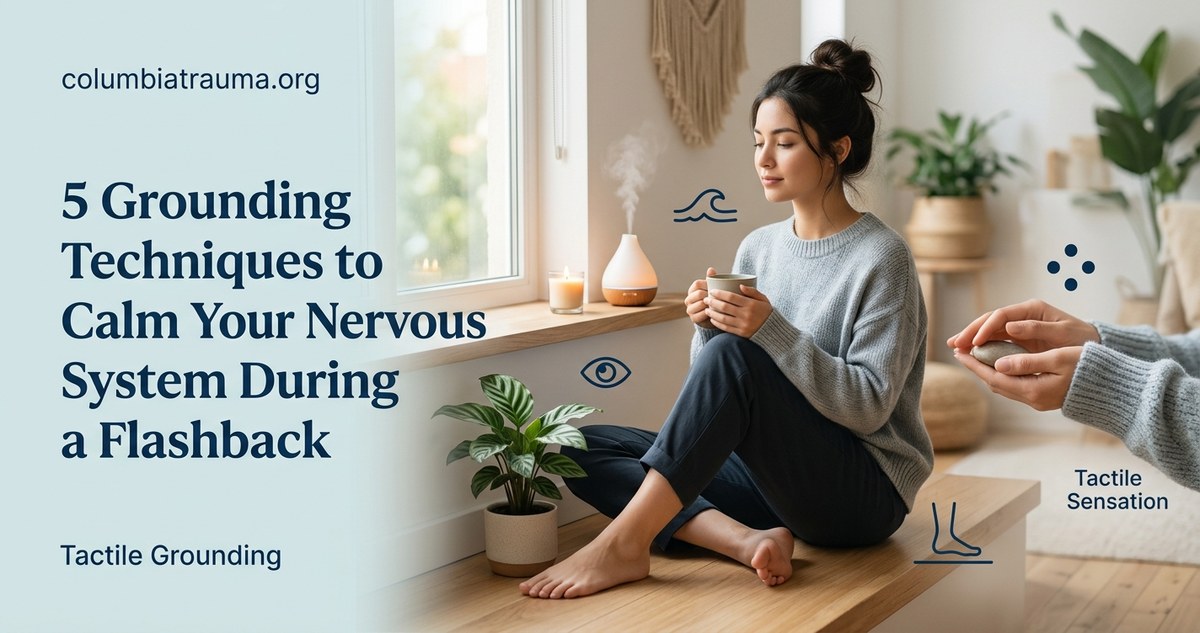
Your heart is racing. Your chest feels tight. The room around you looks different, like you are seeing it through a fog. A smell, a sound, or a texture has pulled you backward, and for a moment, you are not here anymore. You are stuck in a memory that feels more real than the present. This is a flashback, and it is one of the most disorienting symptoms of trauma. But here is the truth you need to hold onto right now: you are safe. The event is over. And there are practical, grounded ways to bring yourself back to the here and now.
Grounding techniques are your emergency anchor during a flashback. They work by shifting your focus away from the traumatic memory and back to your present surroundings. This article covers five immediate methods: the 5-4-3-2-1 sensory check, temperature regulation, deep breathing, body movement, and cognitive tasks. Each technique is designed to calm your nervous system and help you feel safe again, right where you are.
Why Grounding Works When Your Brain Feels Stuck
When you experience a flashback, your brain’s alarm system thinks the danger is happening right now. The prefrontal cortex, the part of your brain that handles logic and time, goes offline. Your amygdala takes over. Grounding techniques work by sending new sensory data to your brain. This data says, “Look, this carpet is soft. I can hear a car outside. I am in 2026, not back then.” Over time, this practice helps your nervous system learn that the present moment is a safe place.
Many adults with C-PTSD or PTSD find that grounding is not about making the flashback disappear instantly. It is about riding the wave without getting pulled under. Each time you ground yourself, you build a small win. That win adds up.
The 5-4-3-2-1 Sensory Check
This is one of the most popular grounding techniques for flashbacks because it uses every sense. It forces your brain to scan the environment instead of the memory.
Here is how you do it:
- Look for 5 things you can see. Name them out loud or in your head. A blue lamp. A crack in the wall. A water bottle. The pattern on your shirt. A shadow on the floor.
- Find 4 things you can touch. Feel the fabric of your chair. Run your fingers over a rough surface. Tap your knee. Hold a cold metal spoon.
- Listen for 3 things you can hear. The hum of a refrigerator. Birds outside. Your own breathing.
- Notice 2 things you can smell. The scent of coffee. The clean smell of soap on your hands.
- Identify 1 thing you can taste. A sip of water. The lingering flavor of mint from your toothpaste.
This technique works best when you say the items out loud. Speaking activates a different part of your brain than thinking. It pulls you further into the present.
Temperature Tricks to Reset Your Nervous System
Your body temperature often changes during a flashback. You might feel cold and numb or hot and flooded. Using temperature in a controlled way can help your system recalibrate.
Try these options:
- Hold an ice cube in your hand. Focus on the cold sensation and the way it melts.
- Splash cold water on your face. The shock is gentle but effective.
- Take a warm shower or place a warm compress on your chest.
- Step outside for 30 seconds if the weather is cool. Let the air hit your skin.
Temperature grounding is a physical anchor. It does not require complex thinking, which is helpful when your mind feels chaotic.
Breathing That Actually Calms Your Vagus Nerve
You have heard “just breathe” a thousand times. But when you are in a flashback, normal breathing can feel impossible. Your breath is shallow and high in your chest. That signals danger to your brain.
Instead of forcing a long inhale, try this:
- Breathe in through your nose for a count of 4.
- Hold for a count of 4.
- Breathe out through your mouth for a count of 6.
- Repeat this cycle 4 times.
The longer exhale is the key. It activates the vagus nerve, which tells your heart rate to slow down. If counting feels too hard, just focus on making your exhale longer than your inhale. Even two cycles can shift your state.
Body Movement to Shake Off the Freeze
Flashbacks often trigger a freeze response. Your muscles tense up, and you feel stuck. Movement can interrupt that freeze and remind your body that you can move, you can choose, and you are in control.
Here are some movement-based grounding techniques:
- Press your feet into the floor. Stand up and feel the ground beneath you. Wiggle your toes.
- Shake your hands and arms. Literally shake them out like you are flicking water off your fingers.
- Stretch your arms overhead. Reach for the ceiling and hold for 10 seconds.
- Walk slowly around the room. Name each step. “Left foot. Right foot. I am walking in my kitchen in 2026.”
Movement does not have to be dramatic. Small, deliberate actions send a signal of safety to your nervous system.
Cognitive Grounding: Using Your Brain to Stay Put
When your mind is stuck in a traumatic memory, you can use logic and facts to pull yourself back. This is especially helpful if you are in a public place and cannot use loud or physical techniques.
Try these mental exercises:
- Count backward from 100 by 7. This is hard enough to demand focus but simple enough to do under stress.
- Recite the alphabet backward. It feels silly, and that is part of the point. The silliness breaks the spell.
- State five facts about your current location. “I am in a coffee shop on Main Street. It is 3:15 PM on a Tuesday. I am wearing a blue sweater. I am here with my friend. The date is October 7, 2026.”
- Name every state in the United States starting with the letter A. Alabama, Alaska, Arizona, Arkansas.
Cognitive grounding works because it forces your brain to engage in present-moment problem solving. You cannot solve a math problem and relive a trauma at the same time.
What to Avoid During a Flashback
Not all coping strategies are helpful in the middle of a flashback. Some can make things worse. Here is a simple table to help you tell the difference.
| Helpful Techniques | Common Mistakes |
|---|---|
| Using sensory input (cold water, textures, sounds) | Avoiding all sensation and dissociating further |
| Slow, deep breathing with extended exhale | Hyperventilating or holding your breath |
| Gentle movement and stretching | Pacing aggressively or harming yourself |
| Cognitive tasks like counting or naming objects | Ruminating on the details of the traumatic memory |
| Repeating safety statements (“I am safe now”) | Telling yourself “this is stupid” or “I should be over this” |
“A flashback is not a sign of weakness. It is a sign that your brain is trying to protect you from something it believes is still happening. Grounding is how you remind your brain that the danger is in the past.”
* Dr. Janina Fisher, trauma expert
Building Your Grounding Toolkit for the Long Run
One technique will not work every time. That is normal. Some days, the 5-4-3-2-1 method will feel like a miracle. Other days, you might need to shake your whole body and then sit in a warm bath. The goal is to have options.
Consider creating a small grounding kit you can keep in your bag or car. Include items that engage your senses:
- A small bottle of lotion with a calming scent (lavender or sandalwood)
- A smooth stone or a textured keychain
- A photo that makes you feel safe
- A printed list of your favorite grounding techniques
When a flashback hits, you do not have to remember what to do. You just reach for your kit.
When Grounding Is Not Enough
Grounding techniques are a first aid tool. They help you survive the moment. But if you are having frequent flashbacks, it may be time to look at the bigger picture. Working with a trauma-informed therapist can help you address the root causes of your flashbacks and build long-term resilience.
Learning to understand your trauma triggers and how to manage them effectively is a key part of recovery. You might also benefit from exploring how to create a safety plan for PTSD flashbacks with a professional. And remember, recovery is not a straight line. Some days will be harder than others. That does not mean you are failing.
Finding Your Anchor in the Storm
You do not need to master all five techniques at once. Pick one. Maybe it is the ice cube. Maybe it is the breathing. Try it the next time you feel that shift in your body. The one that says a flashback might be coming. Use your technique. Notice what happens. Even a small shift is a victory.
You have survived every hard moment so far. You can survive this one too. Grounding is just a way to remind yourself of that truth, one breath, one touch, one fact at a time.