
<|start_header_id|><|start_header_id|><|start_header_id|><|start_header_id|><|start_header_id|><|start_header_id|>
Your nervous system has been sounding the alarm for a long time. After trauma, whether from a single event or years of emotional abuse, your body stays stuck in a state of high alert. Your heart races at small sounds. Your muscles stay tense. Sleep feels impossible. This is not a character flaw. It is a biological response called nervous system dysregulation. The good news is that your brain and body can learn to settle back down. It takes practice, but each small habit builds a foundation of safety.
Nervous system regulation after trauma is possible through daily intentional habits. This article covers seven practical routines, from grounding exercises to breathwork, that help calm hyperarousal and restore balance. You will also learn what mistakes to avoid and how small consistent actions rewire your body’s stress response over time.
Why Trauma Keeps Your Nervous System on High Alert
Trauma changes how your brain processes danger. Your amygdala, the part that detects threats, becomes overactive. Your prefrontal cortex, the part that helps you think clearly, takes a back seat. This survival shift was useful during the traumatic event. It helped you react fast. But when the danger passes and your system stays stuck, everyday life feels exhausting.
You might notice these signs of a dysregulated nervous system:
- Hyperarousal: Feeling jumpy, irritable, or unable to relax. Your body is always ready for a fight.
- Hypoarousal: Feeling numb, spaced out, or disconnected. Your body has shut down to conserve energy.
- Sleep disruption: Trouble falling asleep, staying asleep, or having nightmares.
- Digestive issues: Stomach pain, nausea, or changes in appetite linked to stress hormones.
- Emotional swings: Intense anger, sadness, or panic that feels out of proportion to the situation.
These symptoms are not random. They are signals that your nervous system needs support. The habits below offer a path back to balance.
The Foundation of Nervous System Regulation
Before jumping into specific habits, it helps to understand the goal. Regulation does not mean feeling happy all the time. It means your nervous system can adapt. You can feel stress and then return to calm. You can feel sadness and still function. You build this flexibility through repeated daily actions that signal safety to your brain.
Your vagus nerve plays a central role here. This long nerve runs from your brainstem to your abdomen. It controls your relaxation response. When you activate your vagus nerve, your heart rate slows, your breathing deepens, and your body stops producing as much cortisol. Simple habits like humming, cold exposure, and slow breathing stimulate this nerve.
Consistency matters more than intensity. A two minute breathing exercise every morning will help you more than a single hour long session once a month. Your brain learns from repetition. Each time you practice regulation, you strengthen the neural pathways that support calm.
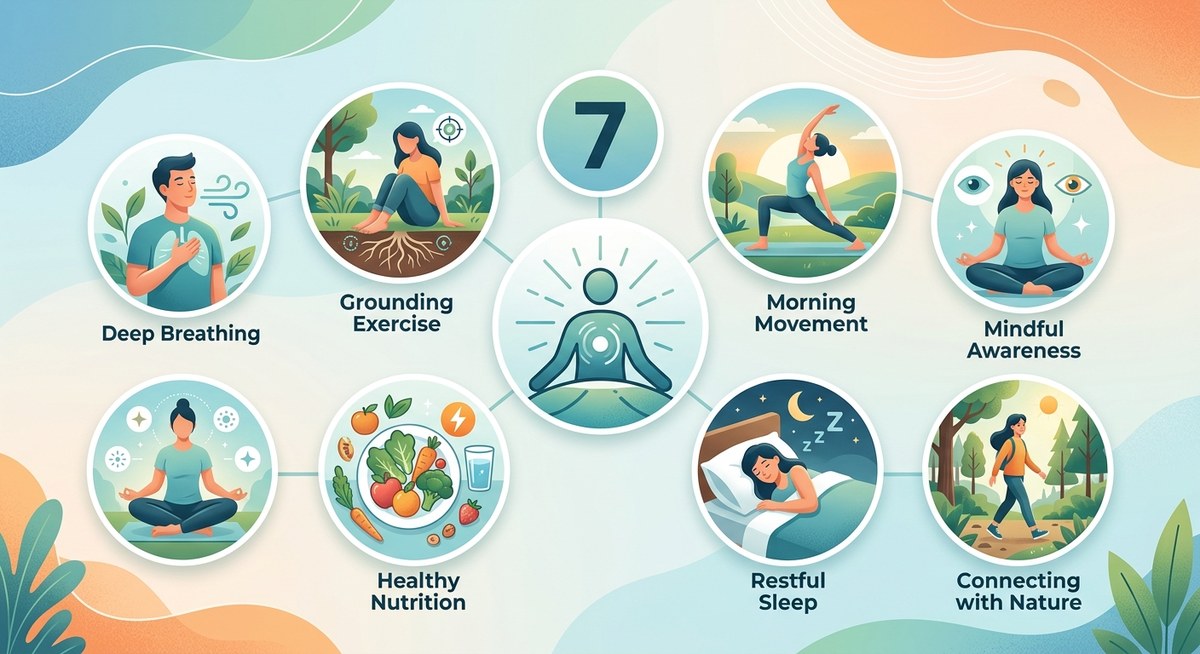
7 Daily Habits to Regulate Your Nervous System After Trauma
These seven habits are designed to fit into a real day. You do not need a meditation retreat or expensive equipment. You just need a willingness to try small changes.
-
Morning grounding with your senses. When you wake up, your nervous system is vulnerable. Before you touch your phone, take 60 seconds to ground yourself. Name three things you see, two things you hear, and one thing you feel. This simple practice pulls your brain out of survival mode and into the present moment.
-
Slow, extended exhales. Your breath is a direct lever on your nervous system. Inhales activate your sympathetic system (fight or flight). Exhales activate your parasympathetic system (rest and digest). Practice extending your exhale. Breathe in for four counts. Breathe out for six or eight counts. Do this for two minutes after you brush your teeth.
-
Gentle movement before coffee. Trauma often lives in the body as held tension. Movement helps release it. You do not need a hard workout. Try a slow walk, gentle stretching, or shaking your arms and legs for 30 seconds. The goal is to move with awareness, not to push through pain. For more on how movement fits into a broader recovery plan, see practical steps to support trauma recovery and rebuild your life in 2026.
-
A midday sensory reset. By noon, stress has likely built up. Step away from your workspace. Splash cold water on your face. Step outside and feel the air on your skin. Hold something textured, like a stone or a piece of fabric, and focus on how it feels. These sensory inputs remind your brain that you are safe right now.
-
One minute of humming or singing. Humming vibrates your vocal cords and stimulates your vagus nerve. Choose a song you like or just hum a single note. Feel the vibration in your chest and throat. This habit is especially helpful during moments of anxiety or after a difficult conversation.
-
Evening reflection without judgment. Trauma survivors often replay the day’s mistakes. Instead, try a different kind of reflection. Write down one thing that felt okay today. It can be as small as a warm cup of tea or a kind text from a friend. This trains your brain to notice safety cues. If writing feels triggering, just say it out loud. For more on building a self care practice, check out how to create a trauma-informed self-care routine that actually works.
-
Consistent sleep timing. Your nervous system craves predictability. Going to bed and waking up at the same time each day, even on weekends, helps regulate your cortisol rhythm. Dim the lights an hour before bed. Avoid screens. Create a wind down ritual that signals to your body that the day is over.
Common Mistakes That Disrupt Regulation
Even with good intentions, some habits can backfire. The table below compares helpful approaches with common pitfalls.
| Helpful Approach | Common Mistake | Why It Matters |
|---|---|---|
| Slow, extended exhales | Rapid, shallow breathing or breath holding | Fast breathing reinforces panic. Slow exhales activate calm. |
| Gentle movement like walking or stretching | Intense workouts without proper cool down | High intensity can spike cortisol if your system is already stressed. |
| Grounding through the senses | Forcing yourself to stay in a flashback | Grounding works when you choose it. Forcing it can feel invalidating. |
| Humming or singing to stimulate the vagus nerve | Staying silent or holding tension in your throat | Vocal vibration directly activates the calming pathway. |
| Consistent sleep schedule | Sleeping in on weekends to catch up | Irregular timing confuses your internal clock and worsens dysregulation. |
| Noticing one okay moment each day | Obsessively reviewing what went wrong | Gratitude practices should feel light. Overanalyzing keeps you in hyperarousal. |
If you notice yourself falling into these mistakes, do not judge yourself. Awareness is the first step to change. You can always adjust your approach.
Warning Signs Your Nervous System Needs Professional Support
Daily habits are powerful, but they are not a substitute for professional care. Some symptoms require more than self regulation. Consider reaching out to a therapist if you experience:
- Flashbacks that feel as real as the original event
- Panic attacks that leave you unable to function
- Self harm or suicidal thoughts
- Inability to leave your home or maintain basic routines
- Substance use that has increased since the trauma
Therapy offers a structured space to process the trauma itself. Self regulation habits support that work. They are not meant to replace it. If you are curious about what therapy looks like, learn more about understanding the role of therapy in healing from PTSD.
Expert Insight on Nervous System Regulation
“Regulation is not about never feeling triggered. It is about how quickly you return to baseline after a trigger. With practice, that return time shortens. The goal is resilience, not perfection.” — Dr. Stephen Porges, developer of the Polyvagal Theory
This perspective is freeing. You do not have to avoid all triggers. You just need to build a nervous system that can bounce back. Each time you use a grounding technique after a trigger, you are retraining your body to trust that safety exists.
Building Your Personal Regulation Toolkit
Everyone responds to different tools. What works for one person might not work for another. The key is to try several practices and notice what helps.
Here are some additional tools you can add to your daily routine:
- Temperature change: A cold rinse at the end of your shower or holding an ice cube can jolt your system out of a freeze response.
- Progressive muscle relaxation: Tense and release each muscle group from your toes to your face. This releases physical holding patterns.
- Orienting: Slowly look around the room and notice five objects. This activates your visual system and reminds your brain that the environment is safe.
- Self compassion phrases: Place a hand on your heart and say, “This is hard. I am allowed to feel this.” This reduces shame, which keeps the stress response active. For more on this, read why self-compassion is essential for trauma recovery.
- Rhythmic movement: Rocking, swaying, or walking in a steady rhythm can calm your nervous system. This mimics the safe rocking infants receive from caregivers.
Start with one tool. Use it for a week. Then add another. Your toolkit will grow over time.
Small Steps Lead to Lasting Change
Healing from trauma is not a straight line. Some days you will feel calm and grounded. Other days your nervous system will feel like a tangled knot. That is normal. The habits in this article are not about perfection. They are about showing up for yourself, one small step at a time.
You deserve to feel safe in your own body. Start today with one habit. Tomorrow, add another. Over weeks and months, your nervous system will learn that it can rest again. You are not broken. You are healing. And every small habit is proof of your strength.